
The Long Game
Some wins take time. Canada’s men’s national soccer team made history, advancing to the FIFA World Cup Round of 16 for the first time ever. Their dramatic 1-0 victory over South Africa, sealed by Stephen Eustaquio’s stoppage-time winner, marked a watershed moment for Canadian soccer and reflected years of steady investment, development and belief. Coach Jesse Marsch called his players “Canadian heroes”, a fitting tribute to a team that has elevated the country’s standing on the world stage. While Canada’s World Cup run came to an end, the team leaves the competition having achieved its best-ever World Cup result and with plenty of optimism for the future.
Duel Mandate
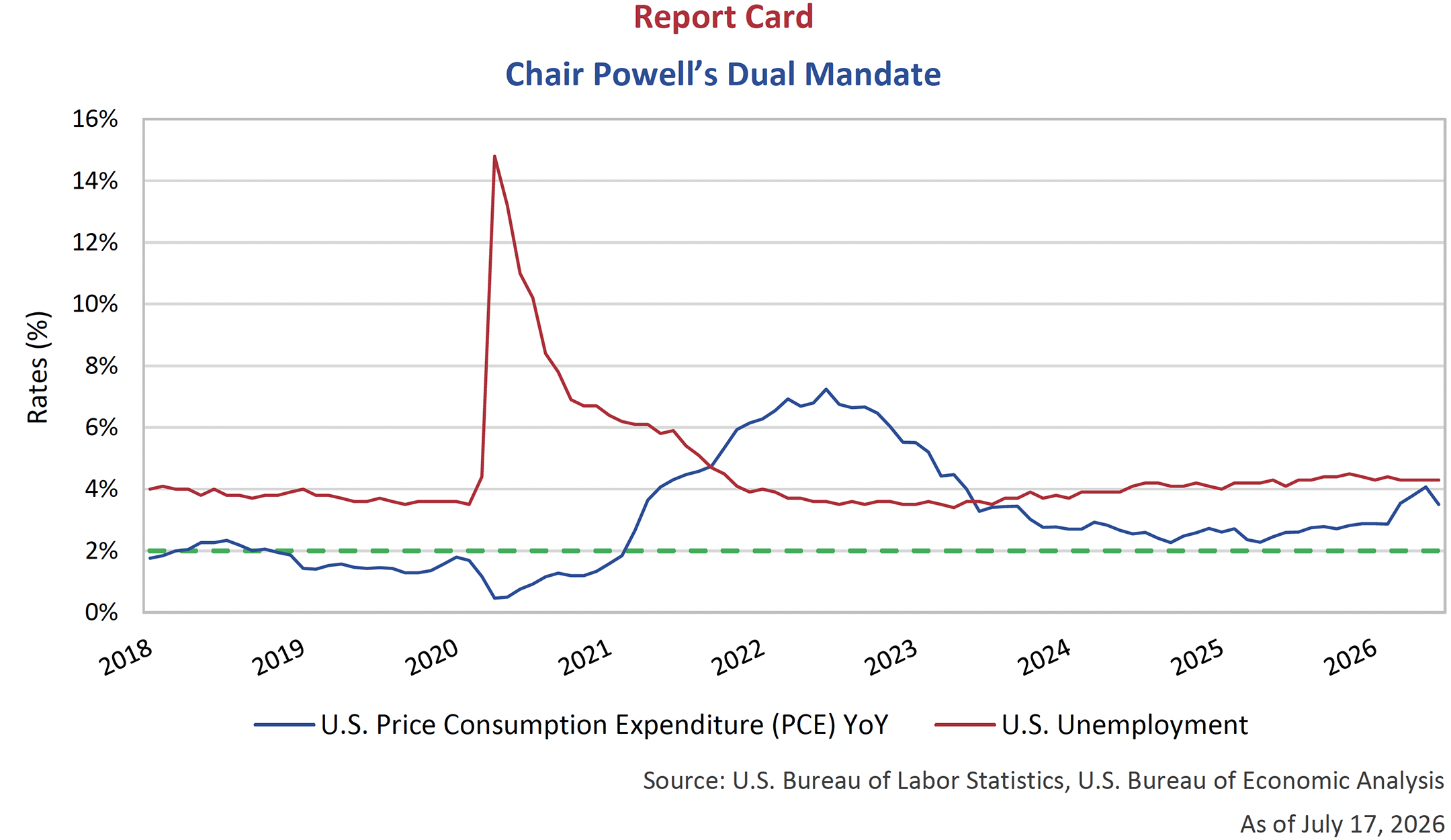
The U.S. Federal Reserve (Fed) entered a new era in May as Kevin Warsh succeeded Jerome Powell as Chair. Powell, who held the position since 2018, leaves the role following an up-and-down tenure. His record is highlighted by how he dealt with the COVID-19 pandemic shock, the inflation surge that resulted in its aftermath and his public clashes with the President. When Powell entered office, benchmark rates were already on the rise after spending nearly a decade at 0%. After hitting 2.5% in 2019, the economy slowed and political pressure began to mount, leading “Powell to throw in the towel” as the Fed cut rates 3 times. A year on, the pandemic was in full swing, and the response from the Fed was deliberate. Interest rates reverted to 0%, circuit breakers were activated and the Fed even committed to buying high yield corporate bonds, if required. Recovery in the financial markets was swift.
Albeit necessary, the aggressive monetary and fiscal measures contributed to a surge in inflation over the following years. The Fed responded by raising rates from 0.25% to 5.50%, the highest level they had reached in 20 years. Financial commenters proffered whether the U.S. economy could pull off a “soft landing” or if a “hard landing” was inevitable. Despite the noise, Powell continued the fight against inflation. When President Trump was re-elected in 2024, the attacks on Chair Powell resurfaced and intensified. This time around, Powell remained steadfast, committed to the Fed’s independence. He has shown great fortitude through this period, as inflation declines back toward target and the U.S. economy has remained resilient amidst higher interest rates.
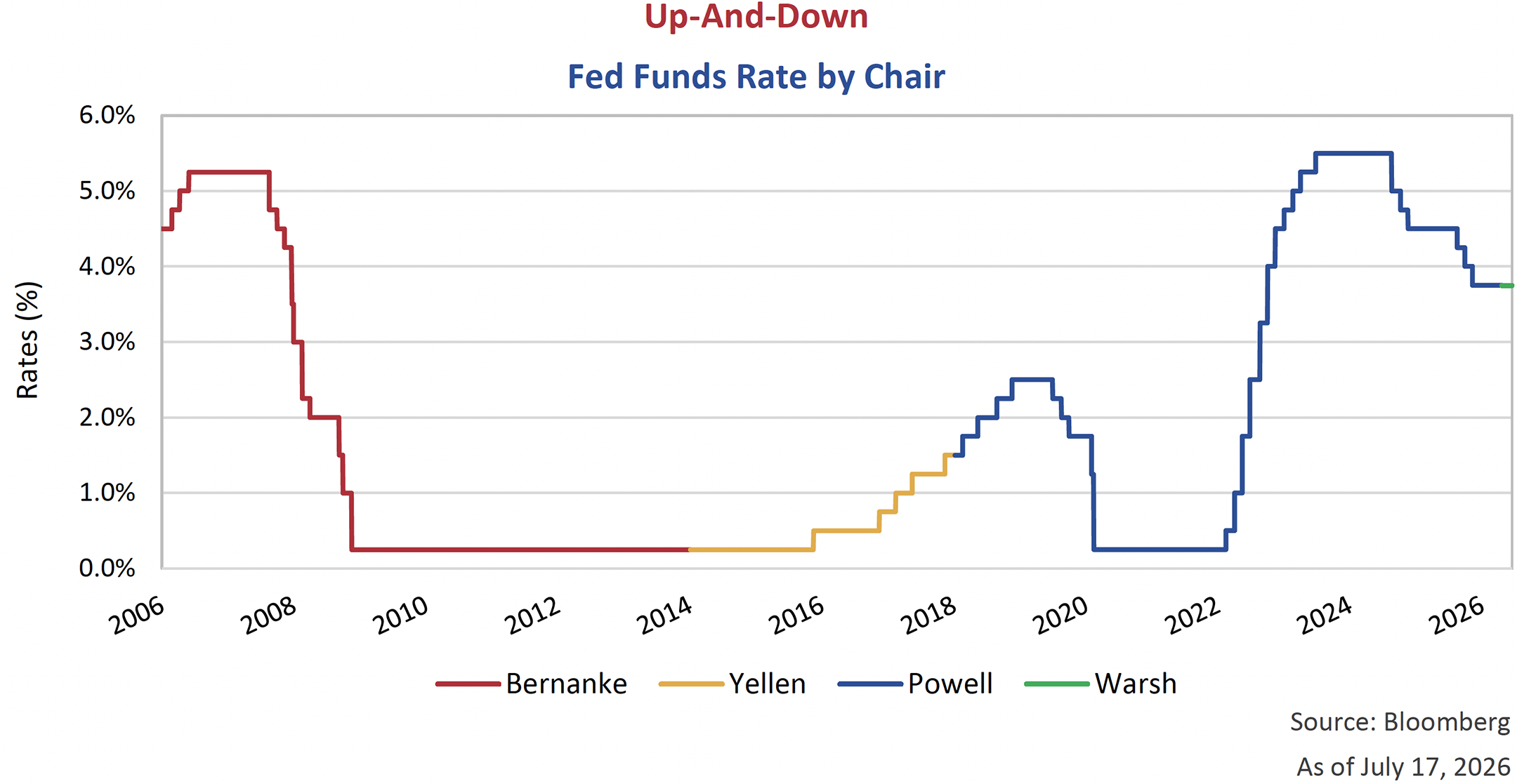
The shift to Warsh has been about more than just the name on the door. Warsh is looking to leave his own mark and has signalled a move away from the Powell-era reliance on forward guidance and the closely watched “dot plot”, declining to submit his own rate projection at his first meeting and arguing that markets should focus more on economic data than Fed forecasts. The result is a less prescriptive, more reactive communication style that could leave markets with greater uncertainty and may cause increased volatility. The Fed’s evolving approach today echoes elements of Alan Greenspan’s deliberately ambiguous “Fedspeak”. The former Chair, who held the position from 1987 until 2006 and helped shape the modern era of central banking, passed away in June at the age of 100.
Getting Messi Out the Curve
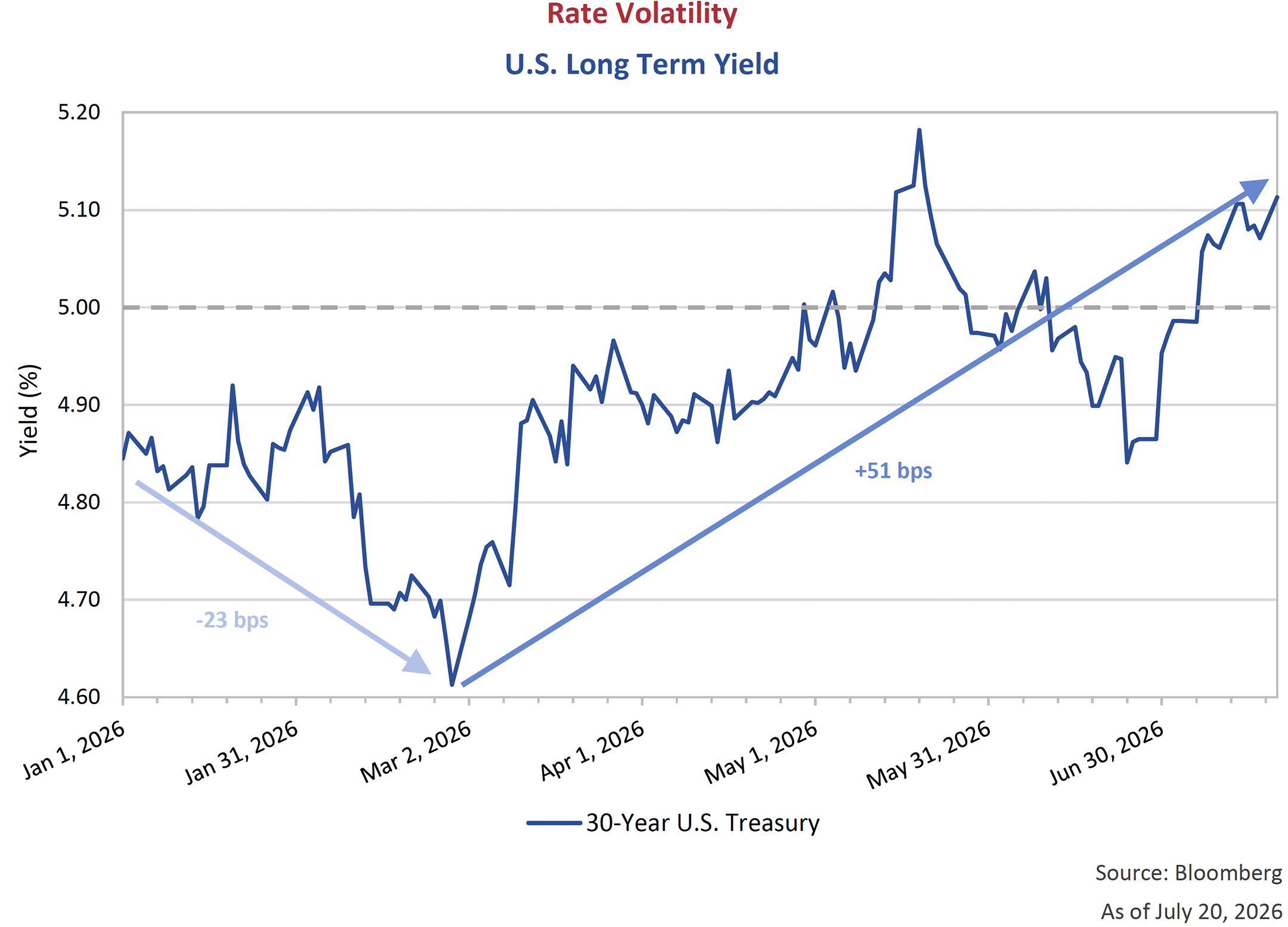
In the United States, Treasury markets remained volatile as investors assessed the future path of Federal Reserve policy and inflation. At the front end of the curve, investor expectations have shifted from pricing in rate cuts to anticipating rate hikes, which has kept short-term yields elevated. At the beginning of the year, 2+ rate cuts were priced into the futures market throughout 2026. Today, those expectations of cuts have changed into expectations of hikes, with 1+ hikes now priced into the market. Further out the yield curve, concerns over mounting fiscal deficits and elevated government borrowing drove investors to demand greater compensation for holding longer-dated debt, pushing the 30-year U.S. Treasury yield above 5.0% for the first time since 2007. We can see in the graph below that after falling 23 basis points (bps) over the first two months of the year, the long-term yield has since risen by 51 bps.
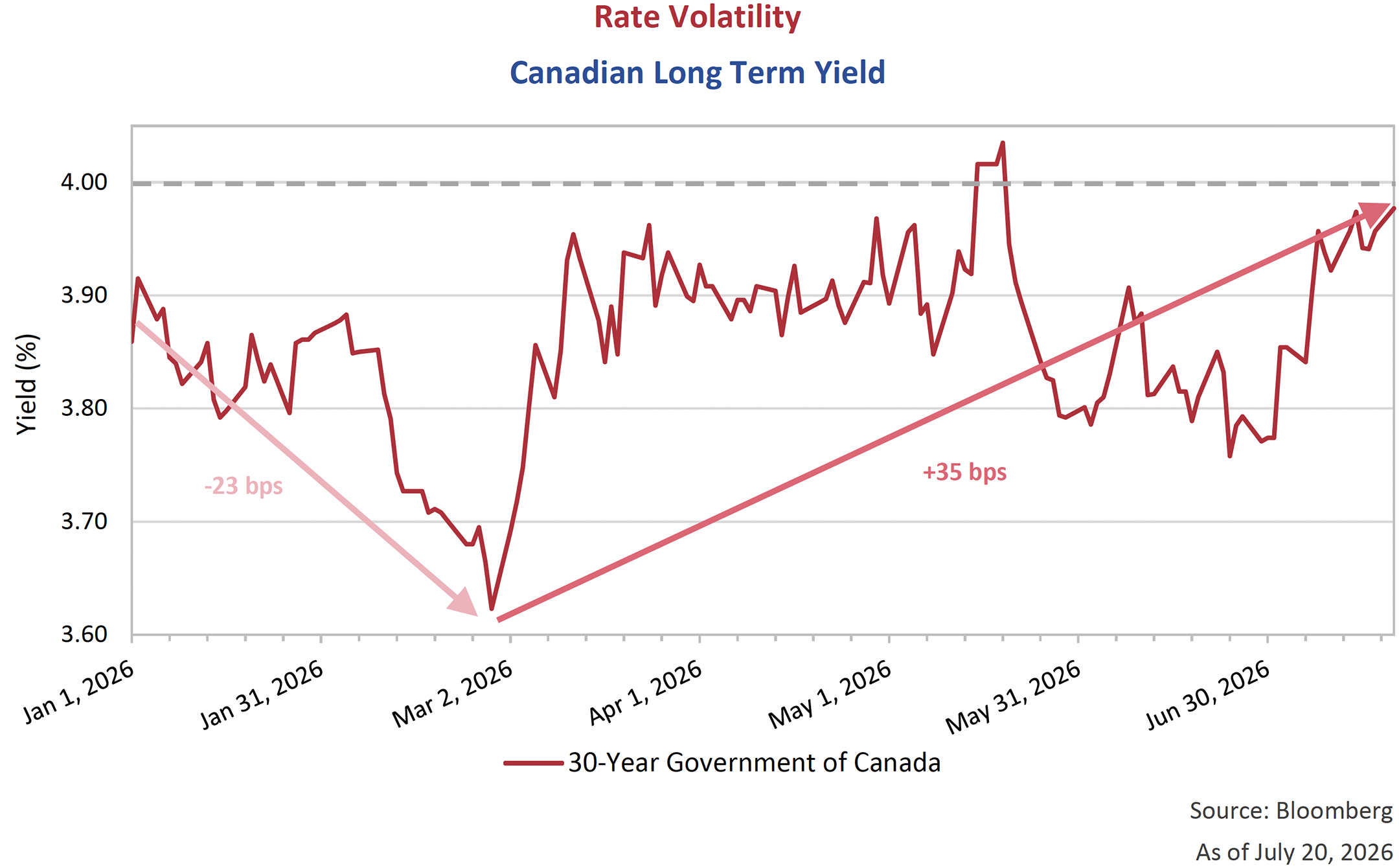
In Canada, yields were range bound as the Bank of Canada navigated a delicate balance between moderating inflation and softer economic growth. Like its U.S. equivalent, the Canadian long-bond fell 23 bps over the first 2 months of the year. Since that drop, the 30-year Government of Canada bond has outperformed its U.S. counterpart, rising only 35 bps to sit close to where it started the year. The Bank of Canada has held its benchmark overnight rate steady over the past 6 meetings. With the economy slipping into a technical recession in the first quarter, policymakers remained in a cautious, wait-and-see posture, weighing the need to support growth against the risk of renewed inflationary pressures.
The Bottom Line
The Canadian yield curve dropped in the second quarter while its U.S. counterpart rose. Despite the offsetting moves, bond markets on both sides of the border ended the period with positive performance. Higher starting yields led the U.S. Broad Bond Index to a positive 0.8% return while the U.S. Corporate Index rose 1.4% with the added benefit of spread tightening. Canadian corporate bonds also experienced positive spread movements. The Canada Broad Bond Index ended the quarter up 1.9% while the Canada Corporate Index rose 2%.
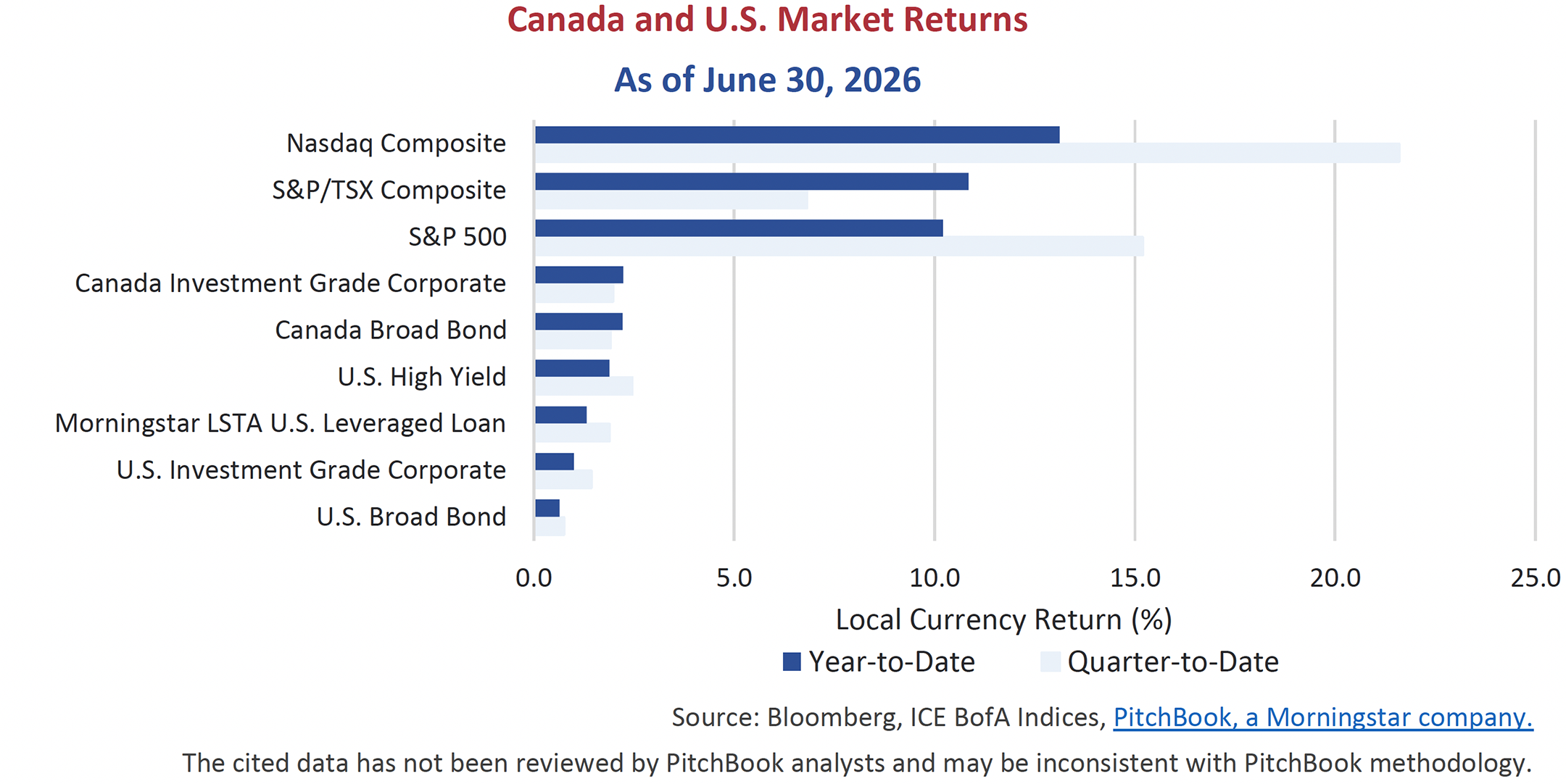
Equity markets rebounded strongly in the second quarter, as investor sentiment improved amid easing trade and geopolitical tensions, resilient economic data, robust corporate earnings, and continued enthusiasm for artificial intelligence. U.S. equities led the advance, with the Nasdaq Composite surging 21.6% as investors returned to large-cap technology and semiconductor stocks. The S&P 500 gained 15.2%, its strongest quarterly performance since 2020, while Canadian equities also posted solid, albeit less spectacular, gains, with the S&P/TSX Composite Index rising 6.8%.
Corporate Action
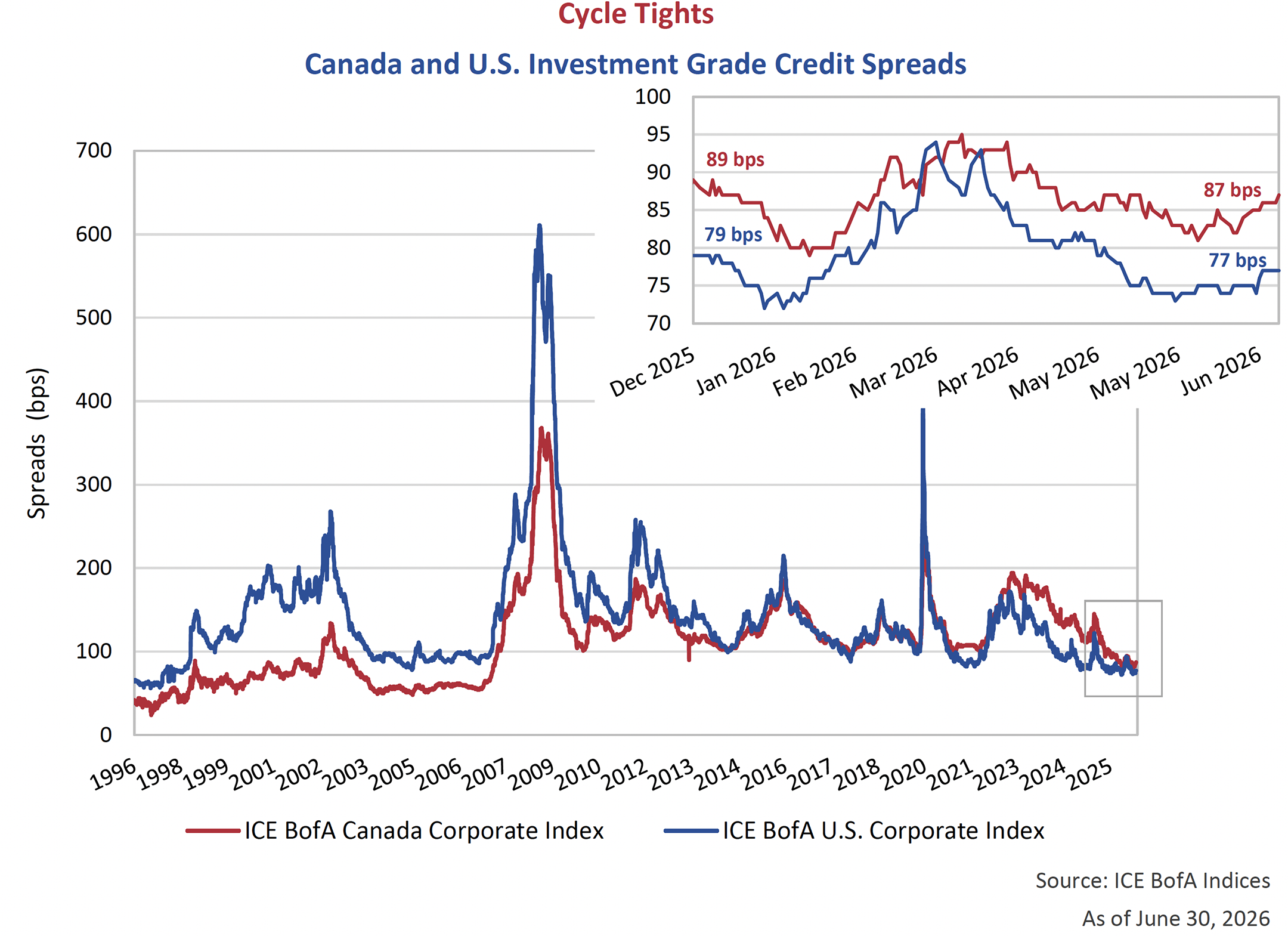
Investment grade spreads remain at historically expensive levels, trading near the tightest range of the current credit cycle and well below long-term averages. The market is assigning a low probability to a meaningful deterioration in corporate fundamentals, leaving investors with limited spread cushion relative to history. At 87 bps in Canada and 77 bps in the U.S., corporate credit spreads are trading 25 bps and 64 bps inside their long-term respective averages. While this does not imply an imminent reversal, the potential for further spread compression appears limited.
Hyper-Issuance
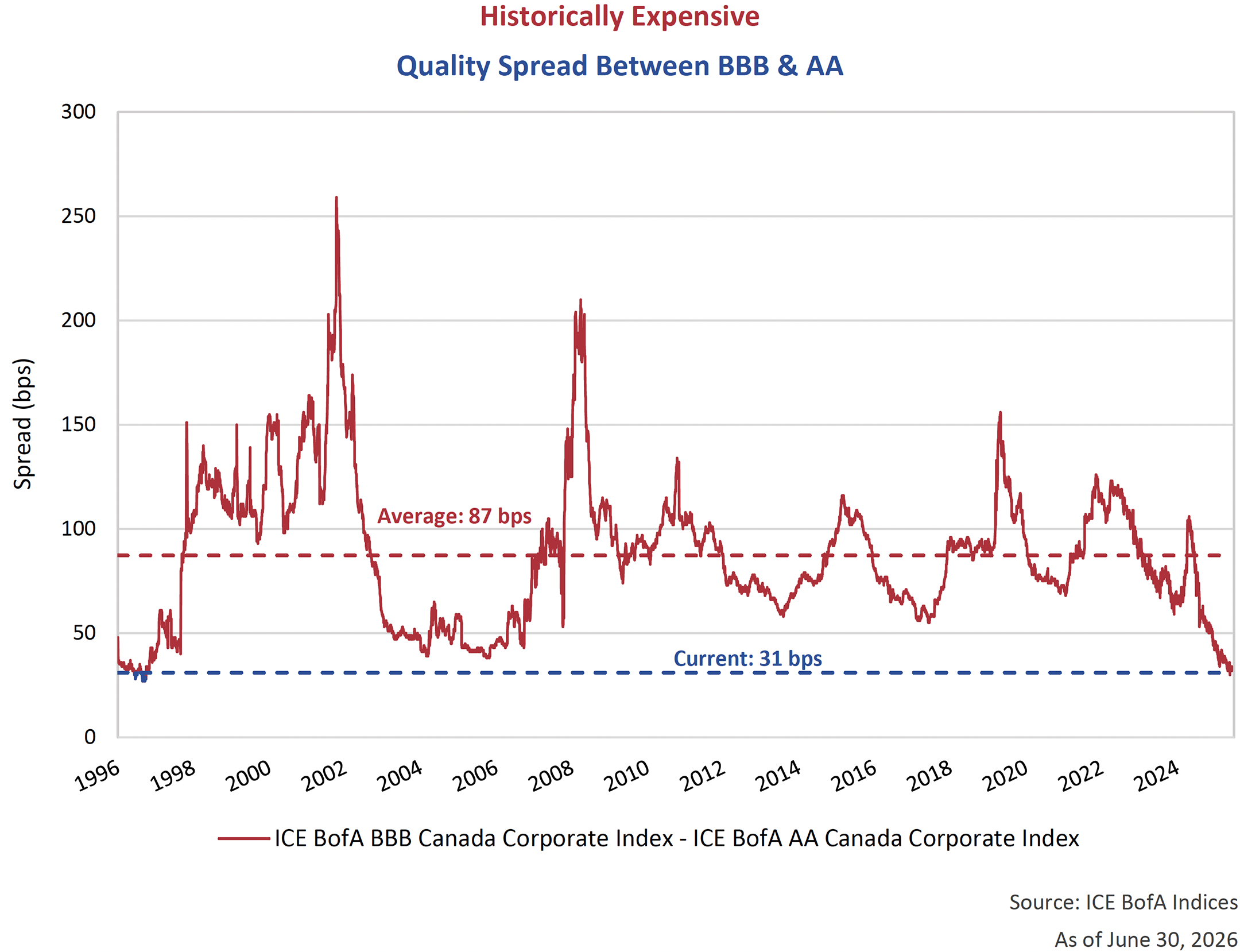
The story of the year for the Canadian corporate bond market has been the record pace of new issuance. Investor appetite for high-quality corporate credit has been persistent as companies looking to borrow have been met by investors happy to lend. Running 50% ahead of 2025 levels, the strength has been broad-based across sectors and rating categories. Perennial BBB issuers, including Bell Canada and TransCanada Pipelines, continue to tap the market at paper-thin risk premiums. A new entrant, BBB-low rated Bird Construction, issued a five-year senior unsecured note. Despite pricing at a spread of just 125 bps over Government of Canada bonds, well inside the historical average of 165 bps for the BBB category, the deal was met with overwhelming demand, more than 8x oversubscribed. BBB rated Molson Coors International also re-entered the Canadian market for the first time in a decade, issuing a 7-year note at a credit spread of 90 bps. As we can see in the chart below, the additional yield premium investors receive for taking on additional credit risk is at historical lows.
Within the new issuance story, Maple bonds have stolen the show. Maple bonds are Canadian-dollar-denominated bonds issued by non-Canadian borrowers. As we highlighted in previous newsletters, Maple issuance doubled in 2025, from $8 billion to $16 billion, after the bonds became eligible for index inclusion. Those numbers now look quaint. In the first six months of 2026, total Maple bond issuance surpassed $35 billion. Notable deals included Goldman Sachs’ $2.75 billion transaction in February, AT&T’s $2.25 billion issuance in March, and New York Life’s $1.1 billion deal in April. However, these issues were eclipsed when U.S. “hyperscalers” entered the Canadian bond market in size for the first time in May.
AA rated Alphabet Inc led the way with an $8.5 billion record-breaking deal. The deal became the largest single day corporate bond new issue in Canadian history, surpassing Coastal GasLink’s $7.15 billion issuance in 2024. The four-tranche Alphabet deal also included record-breaking 5-year, 10-year, and 30-year bonds, at $1.5 billion, $2.5 billion and $2.75 billion, respectively. An impressive deal, the record lasted for all of… 5 weeks! On June 8th, Amazon.com Inc entered the Canadian market with a mammoth $14 billion deal.
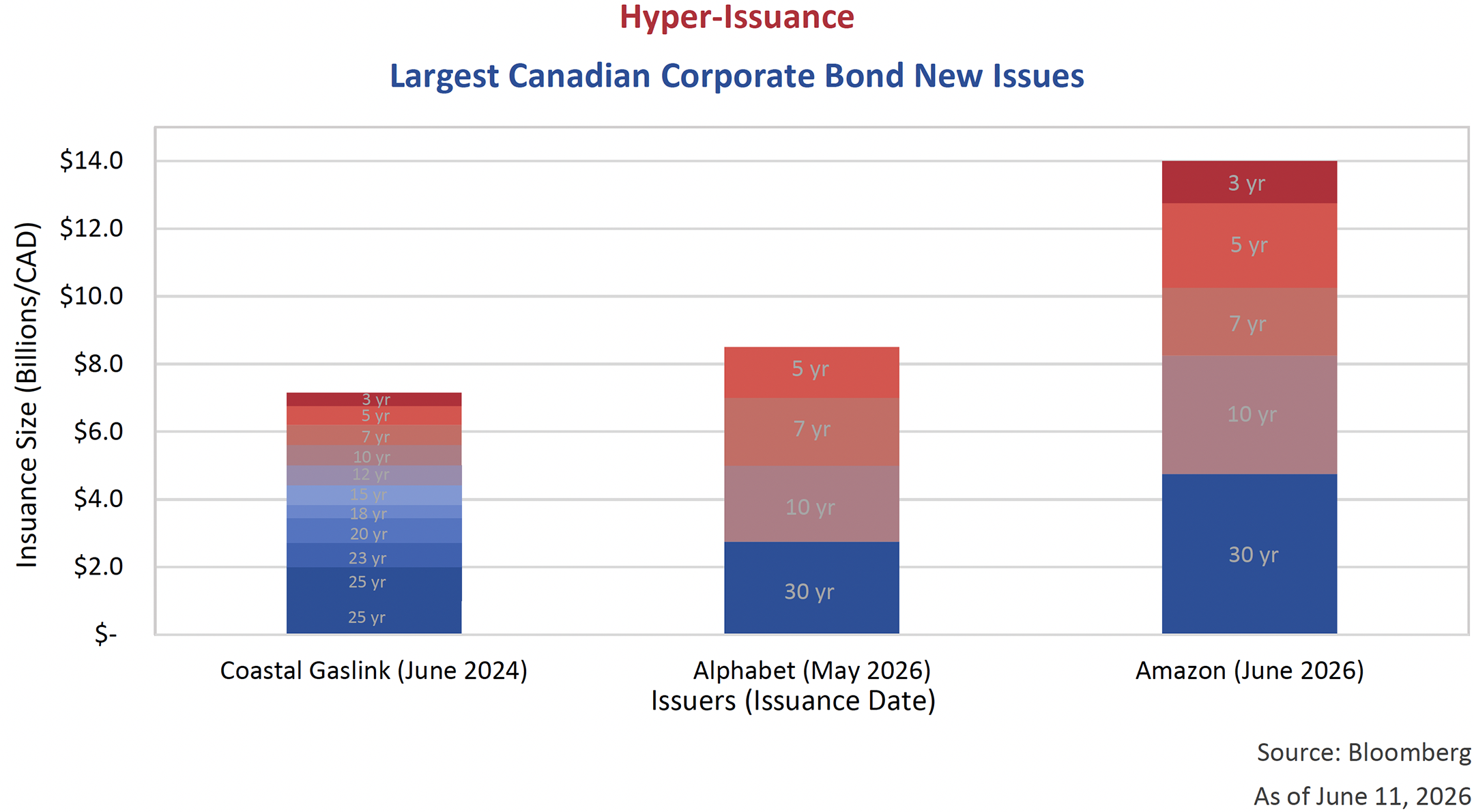
The five-tranche Amazon deal left all records in the dust, highlighted by a $4.75 billion 30-year bond. The size of the 30-year issue truly jumps off the page. Prior to Amazon and Alphabet’s sales, there were only 2 corporate “long-bonds” in the Canadian market larger than $1 billion; a Rogers (formerly Shaw Communications) $1.45 billion 6.75% senior note due 2039 and Health Montreal Collectif’s $1.37 billion 6.721% bond due 2049, which was issued in 2011 to fund the construction of Centre hospitalier de l’Université de Montréal (CHUM) Hospital. The Amazon long-bond included over 100 buyers, both domestic and international, and immediately represents 3% of the long corporate index.
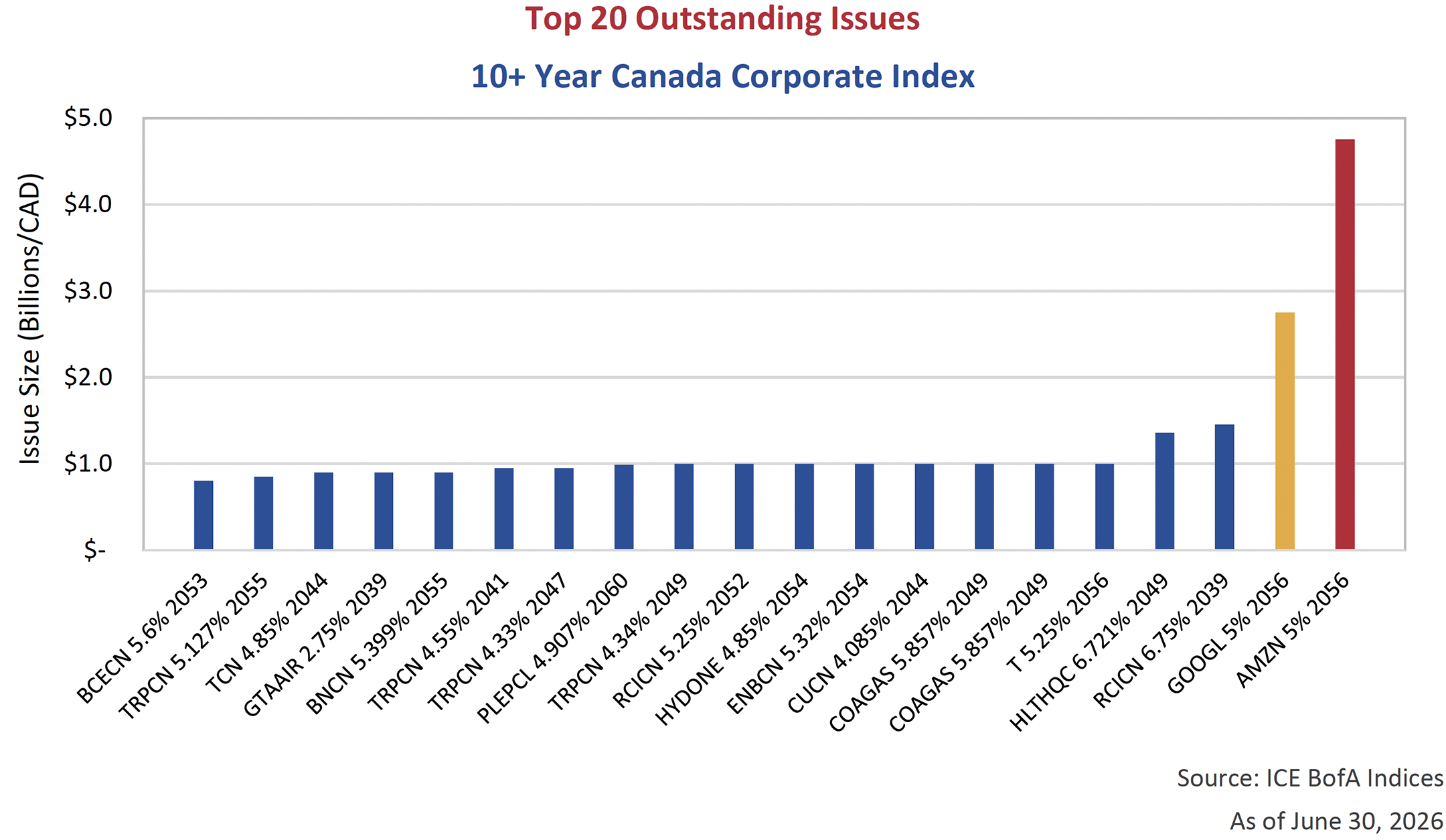
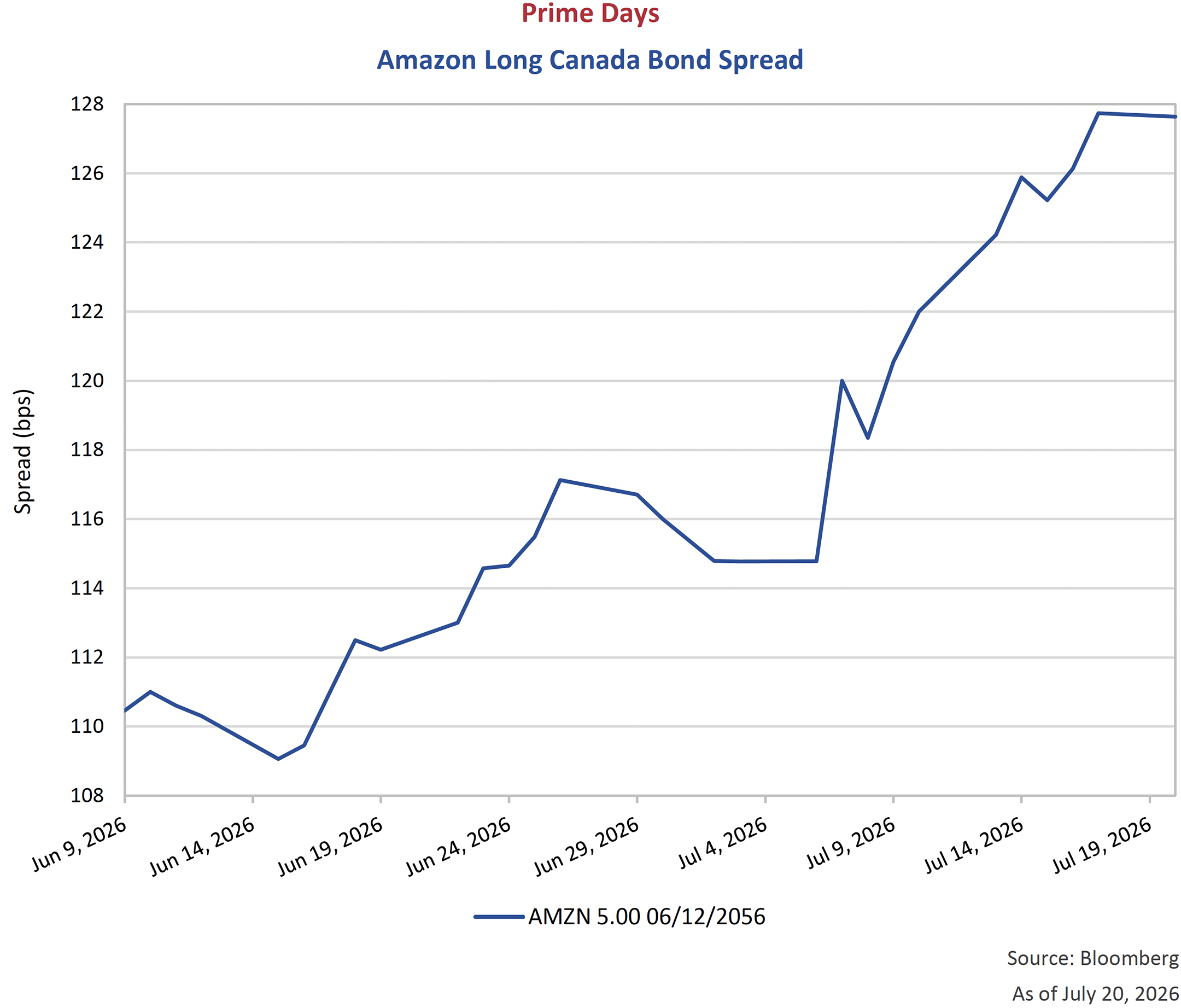
The question now becomes, has there been too much issuance for the market to absorb. This question is not only being asked in Canada, but in the U.S. as well, as hyperscalers have issued close to US$250 billion globally over the past 12 months to fund capex needs. At times, demand has appeared insatiable. But this may be starting to hit a limit. Amazon followed their Canadian issuance in June with a US$25 billion offering in July. The deal was not met with the same enthusiasm from investors as previous issuances and the orderbook showed signs of weakness. We may be starting to see signs of oversupply across the hyperscaler complex as the Canadian-dollar Amazon long-bond has now widened 17 bps since new issue.
Onwards and Upwards
We continue to watch the development of the Limited Recourse Capital Note (LRCN) market with interest. During the second quarter, four notes reached their call windows. All four issuers elected not to call, and their notes extended. The securities will continue for at least another 5 years until the next call windows in 2031. Non-calls were well received by the market, as affected notes saw their coupon rates almost double on reset, enhancing the income profile of these securities.
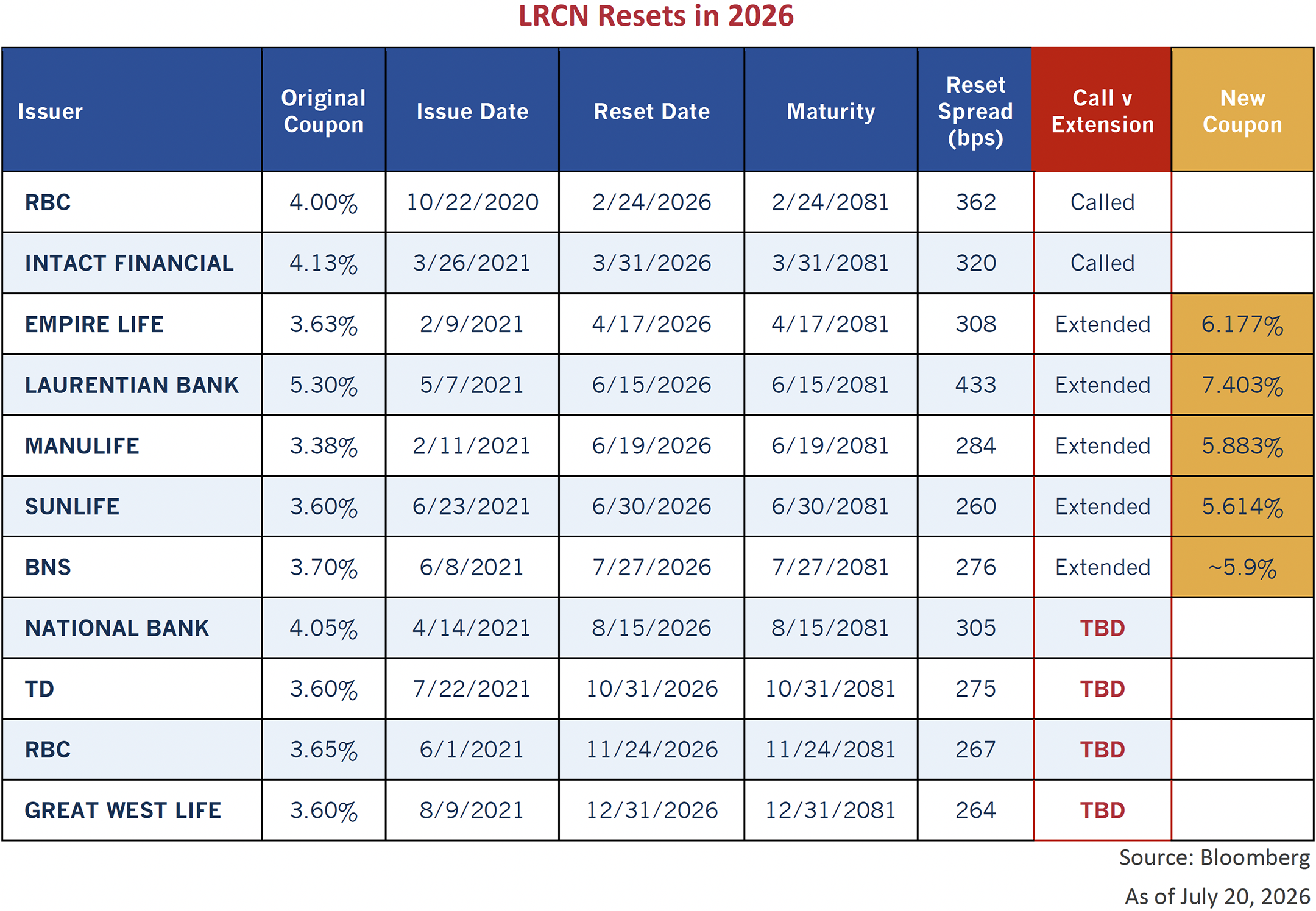
Looking ahead, the decision to redeem or extend the remaining four notes with reset dates in 2026 will depend on the evolution of the credit spread environment, as well as any new LRCN issuance activity by these issuers. In June, National Bank and TD issued new LRCNs in the Canadian market with reset spreads of 295 bps and 285 bps, respectively. It was a surprise to see these deals done in Canada as the trend for Canadian banks has increasingly been to issue AT1 securities south of the border, as pricing has been 30-50bps cheaper than Canadian levels. On pure economics alone, the Canadian deals suggest National Bank has an incentive to redeem its outstanding note resetting at 305 bps, while TD may be more inclined to extend its existing LRCN with a 275 bps reset spread.
A Tale of Two CCCities
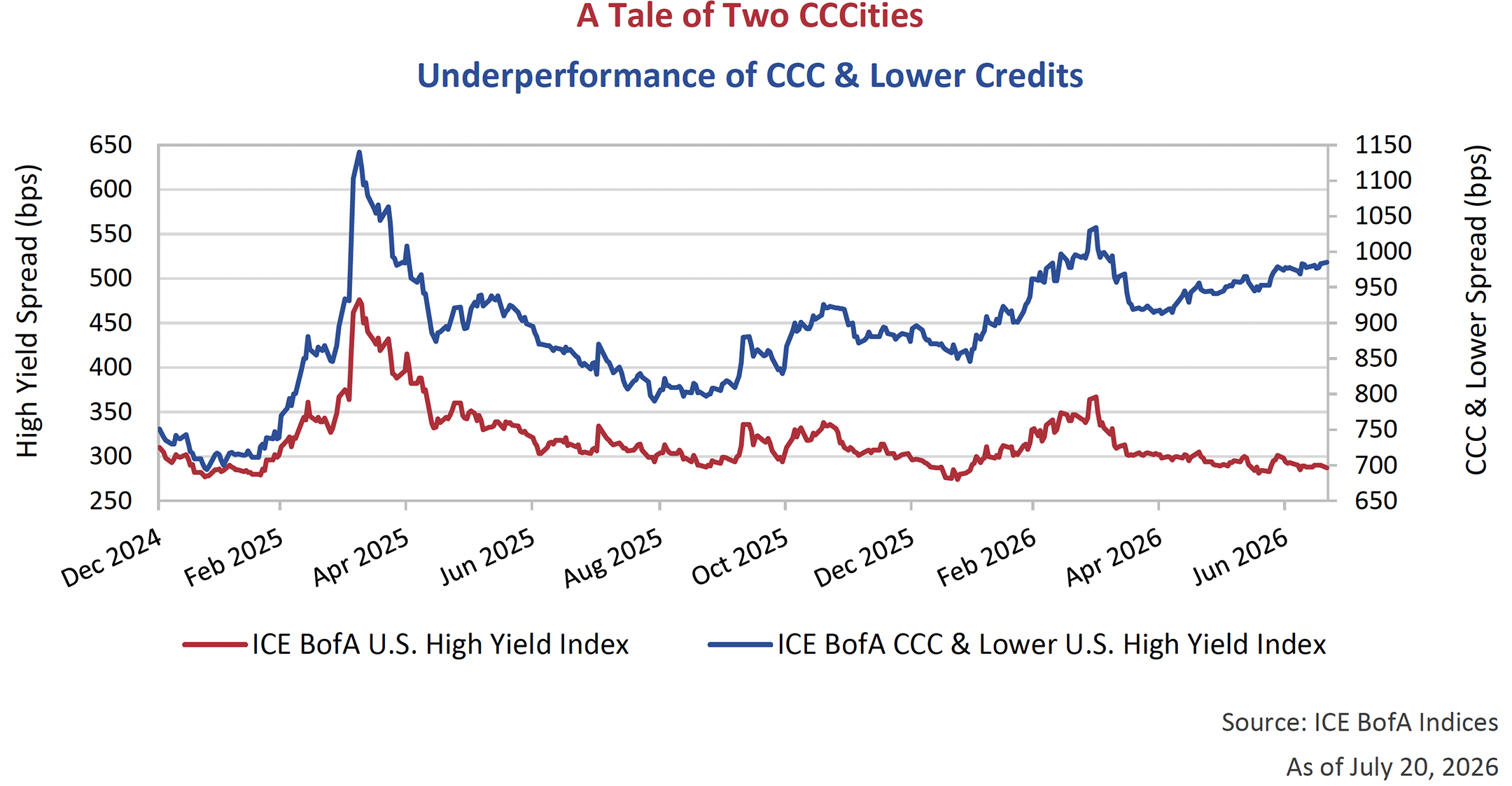
High yield bonds extended their strong performance during the second quarter, with U.S. credit spreads tightening by 55 bps to 294 bps. By quarter-end, spreads were just 50 bps above the Index’s all-time tights, reflecting a market that continues to price in a highly benign credit environment.
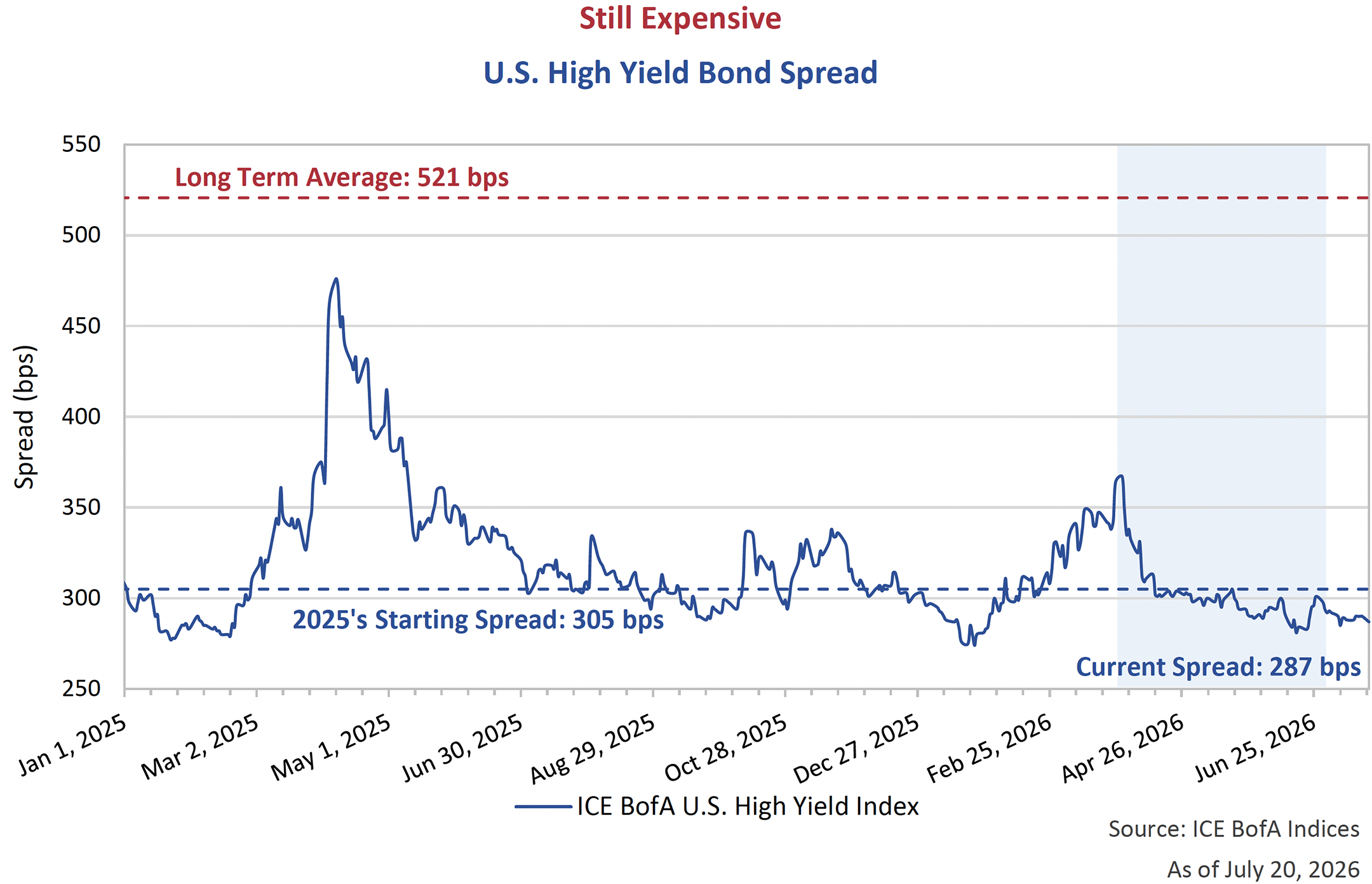
Beneath the headline performance, however, a more nuanced picture emerged across rating bands. While BB and B rated credits tightened by as much as 17 bps, spreads on CCC and lower rated issuers widened by approximately 60 bps. Although the CCC index can be disproportionately influenced by price moves in a handful of distressed issuers, the divergence suggests investors are becoming increasingly selective, distinguishing between issuers with stronger credit fundamentals and resilient access to capital markets and those facing elevated leverage and refinancing risk.
Recent activity among lower rated issuers reinforces why investors have become increasingly selective at the weaker end of the credit spectrum. Colisée Group, a European operator of nursing homes and long-term care facilities, completed a recapitalization in the second quarter that S&P viewed as distressed and tantamount to default. Creditors accepted less than their original contractual claims in exchange for extending maturities and reorganising the capital structure. The transaction highlights the growing reliance on liability management exercises as highly leveraged issuers seek to address balance sheet pressures without a traditional default process.
For investors, the message is increasingly clear. With spreads near historical tights, future returns are likely to be driven more by careful issuer selection than broad market strength. The market is no longer rewarding every issuer equally, and this dispersion is creating both downside risk and upside opportunity. As tight valuations leave little room for error, robust fundamental credit analysis is as critical as ever to preserving capital, and maximising risk-adjusted returns.
To Infinity And Beyond
As we look ahead, markets are increasingly characterized by late-cycle dynamics. Credit spreads remain near historically tight levels, valuations across many asset classes leave little room for disappointment, and investors are being compensated less for broad market exposure than they have been in the past. This does not mean the cycle is ending tomorrow, but it does suggest that the margin for error is narrowing.
In this environment, success will depend on the discipline of careful security selection. The difference between winners and losers is likely to become more pronounced, making fundamental research, rigorous due diligence, and a willingness to challenge consensus increasingly important. Some companies will continue to justify elevated expectations, while others may find that yesterday’s strengths are no longer enough to support today’s valuations. The market’s enthusiastic reception of SpaceX’s Initial Public Offering (IPO) is a reminder that exceptional businesses can continue to command premium valuations when innovation, execution, and long-term opportunity align. But it also reinforces a timeless investment lesson: even the most compelling stories must ultimately be supported by fundamentals. In this environment, generating alpha will depend as much on knowing what not to own as it does on identifying the credits worth owning.